Go Slow
Go Slow
A private record of what you take, and what is worth knowing about it.
What Go Slow is
Draft — awaiting reviewGo Slow is an app for keeping track of what you take, how much, and how it goes. It is made for people who use drugs and want a clear record and good information without being judged for it. Everything it works out, it works out on your own device. It gives advice and it never stops you from recording anything.
What it offers
Draft — awaiting reviewThe app is built around a few things people asked for. None of them comes with a verdict on you.
-
Log an entry for any day. Record what you took, how much and how, for now or for any earlier day. If you are not sure of the amount, say so and the entry still counts. You can rate the amount on your own scale, from low to very high, beside the number or instead of it. You can note how you were feeling going in and what you were hoping for.
-
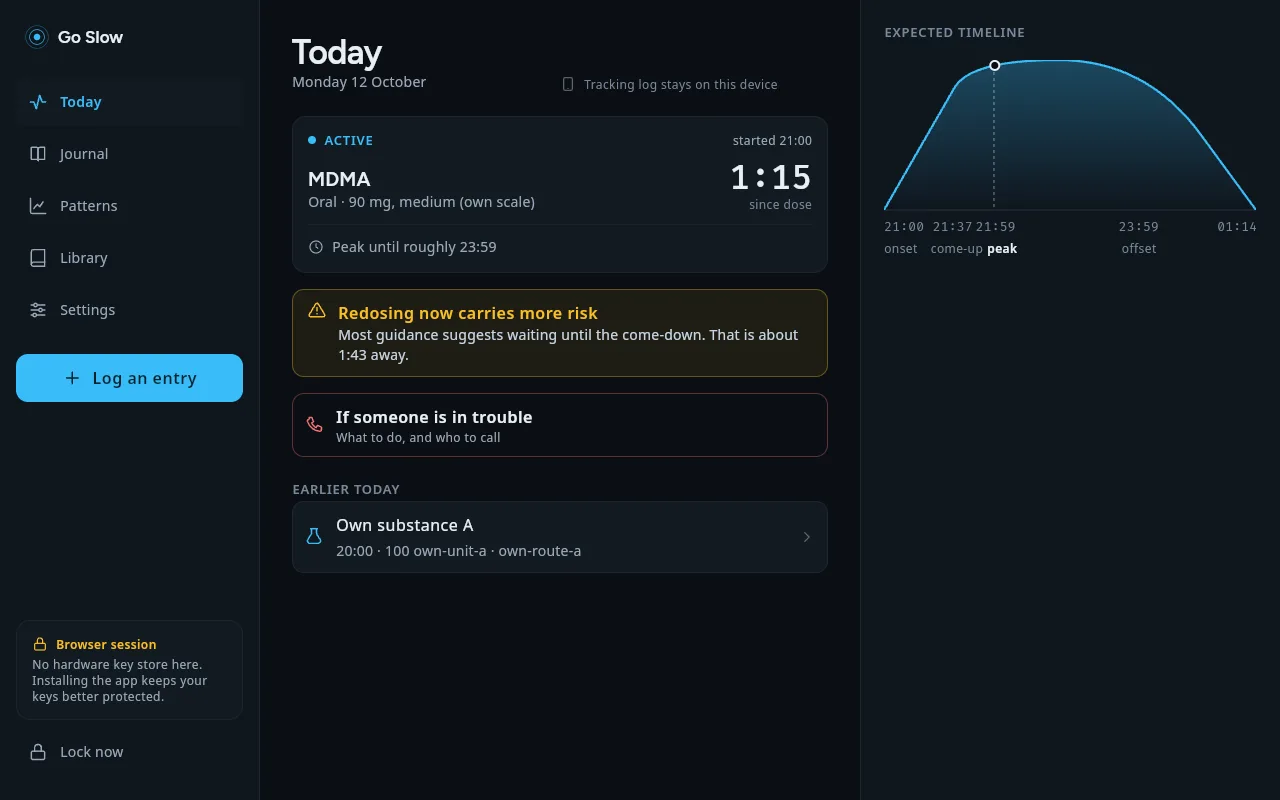
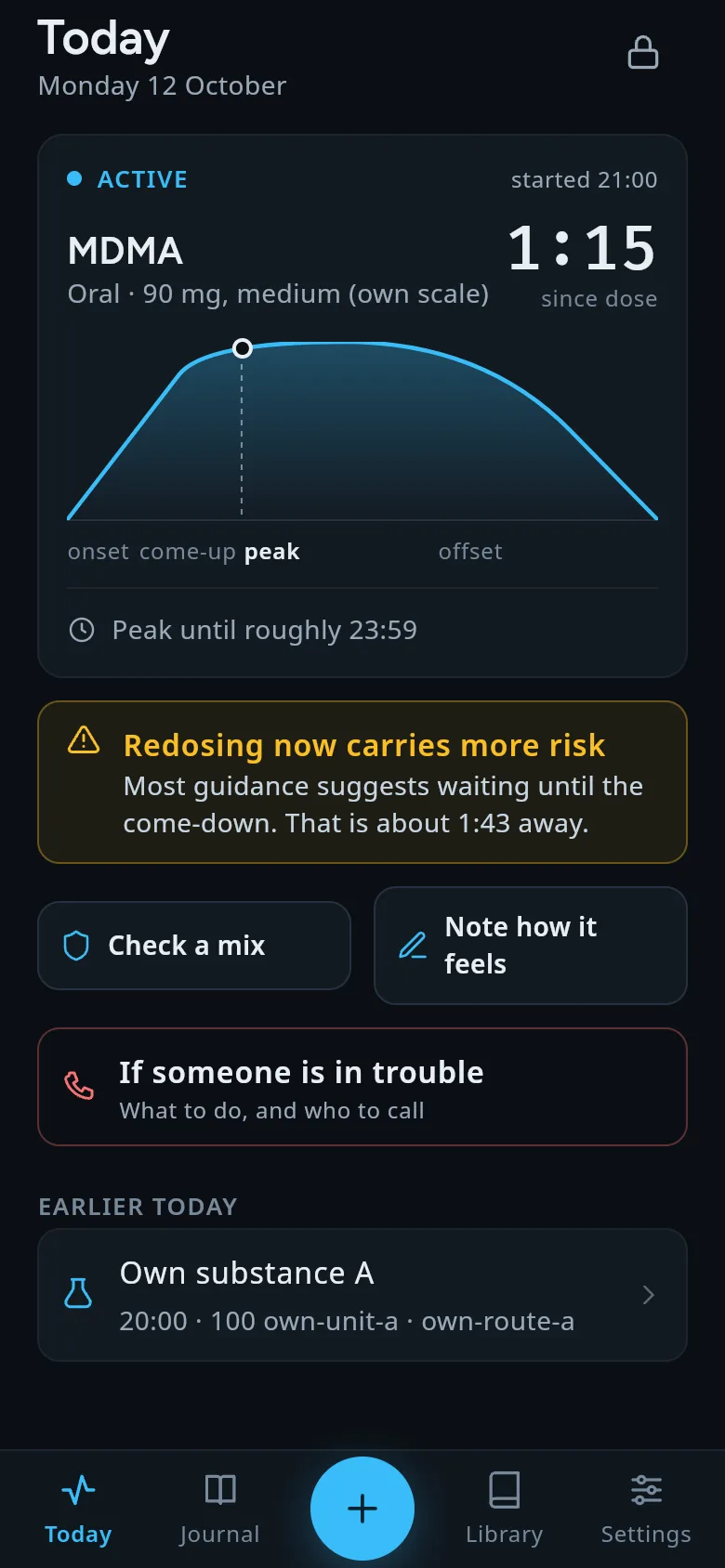
When will this ease off? Today draws an effect curve for what you have taken: when it tends to come up, peak and ease off, using the durations in the library. When more than one thing is running, each gets its own line in its own colour, and a legend names them. If you log another dose while one is still running, the app tells you what that means and leaves the choice with you.
-
A library and a mix check. The library covers 28 substances so far: dose ranges, how long effects last, what is worth knowing, and the sources behind each figure. The mix check takes up to four substances and rates them pair by pair, on the scale harm-reduction charts already use, from low risk to dangerous. Every rating carries a word and a symbol as well as a colour. No data means there is no evidence either way, which is not the same as safe. Learn more about where the library comes from
-
A journal, a diary and your patterns. The journal keeps every entry by day. The diary holds check-ins and notes, where one tap is a complete answer and nothing to say is an answer too. Patterns shows the days you logged, amounts over time and time of day, side by side, with no score and no verdict. Breaks counts the days since your last entry. It counts and does not judge, and you can hide it.
-
If someone is in trouble. One screen sets out what to do, step by step, and it works without a connection. It is general first-response guidance, not a diagnosis.
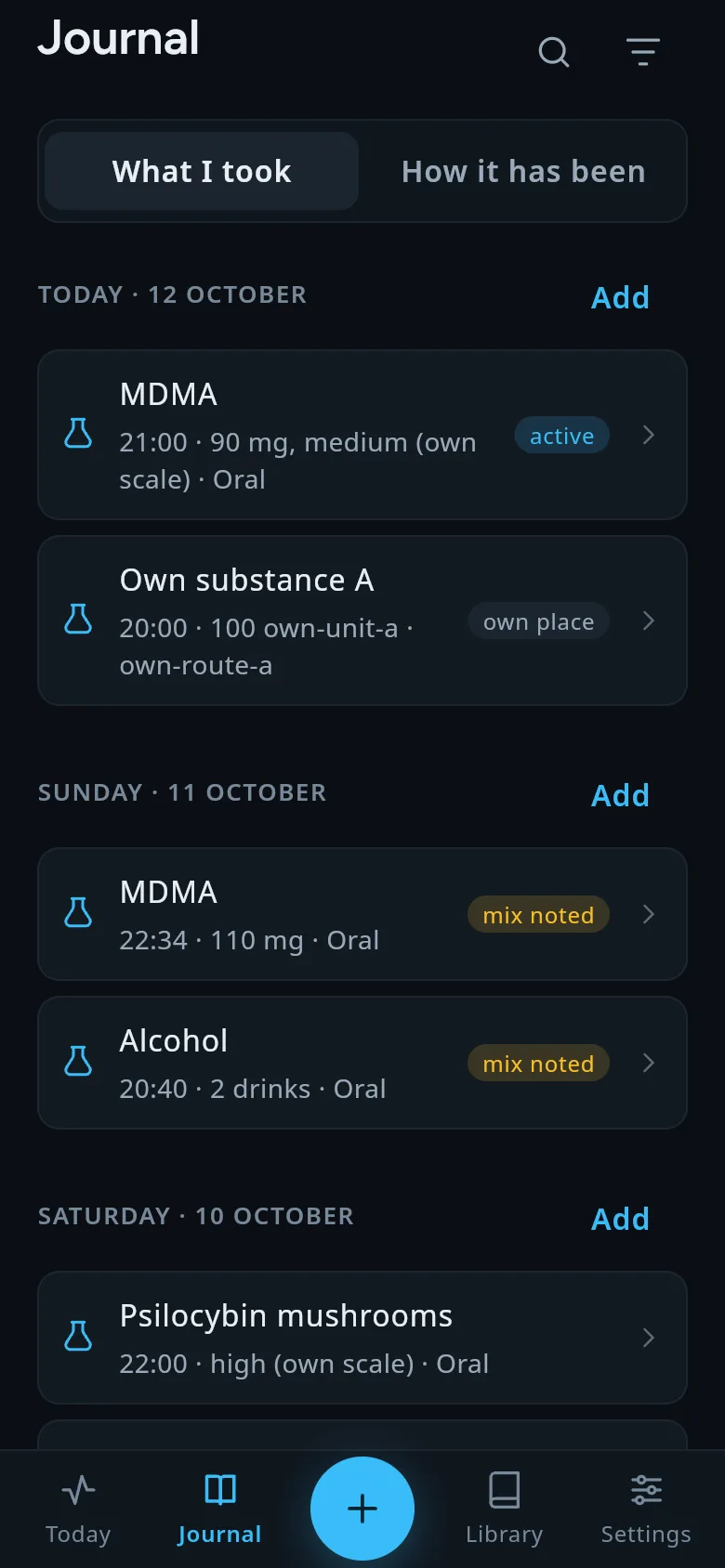
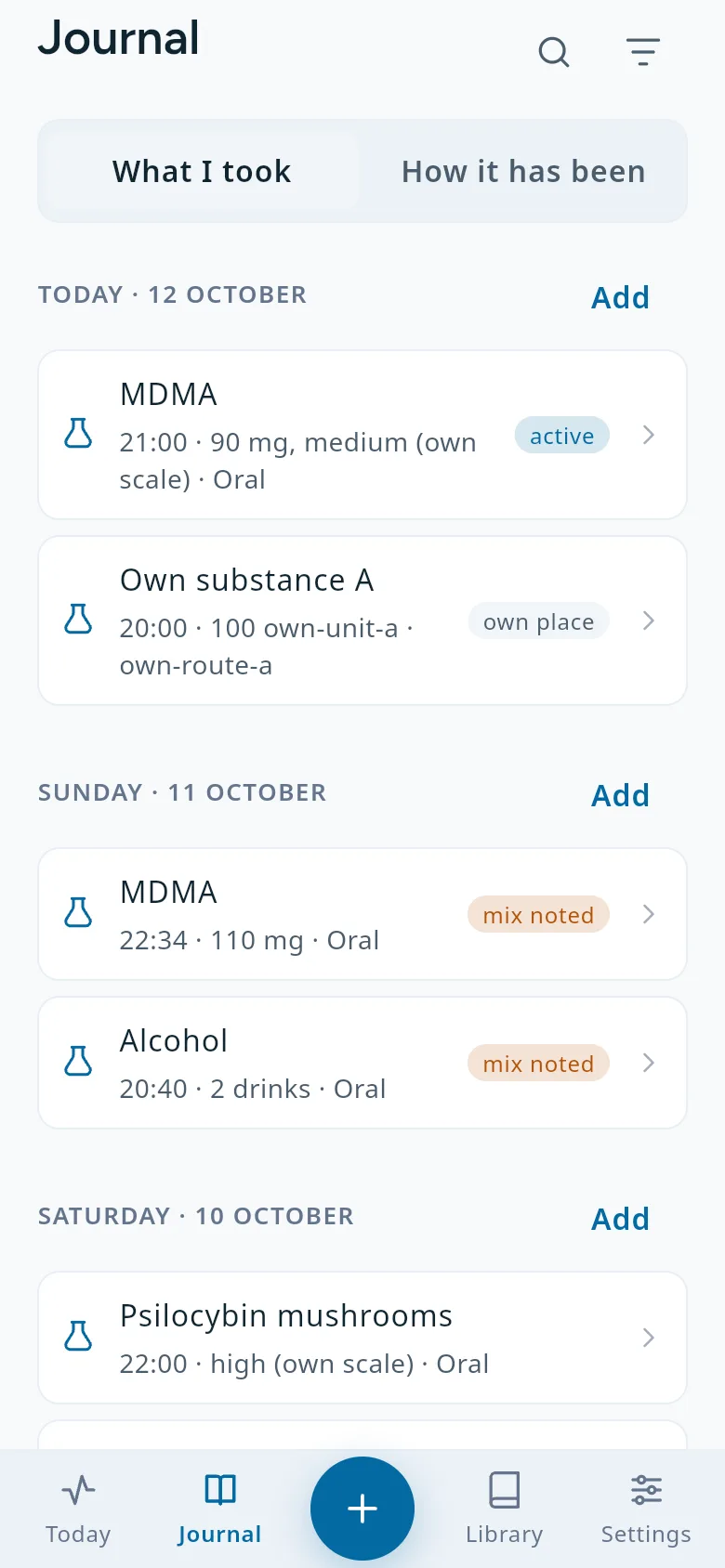
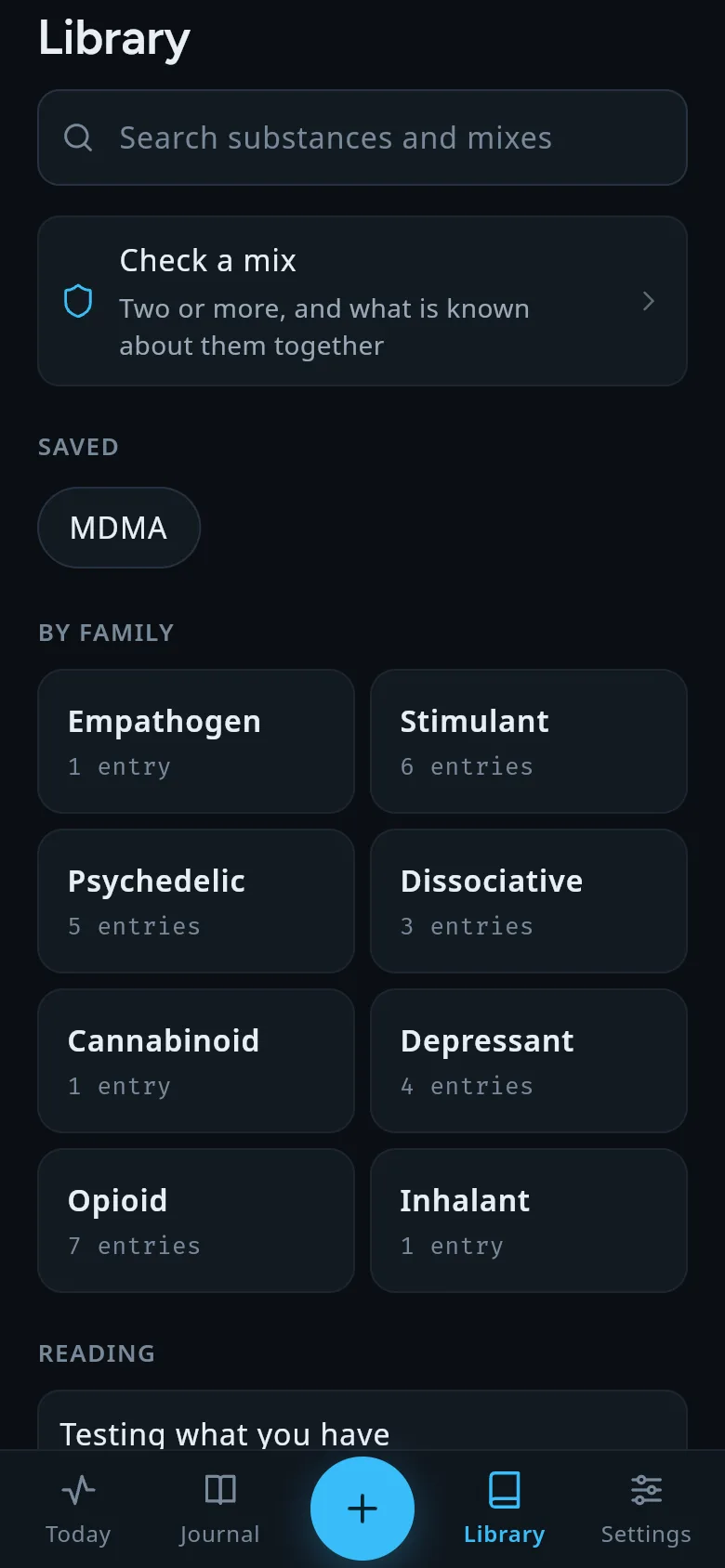
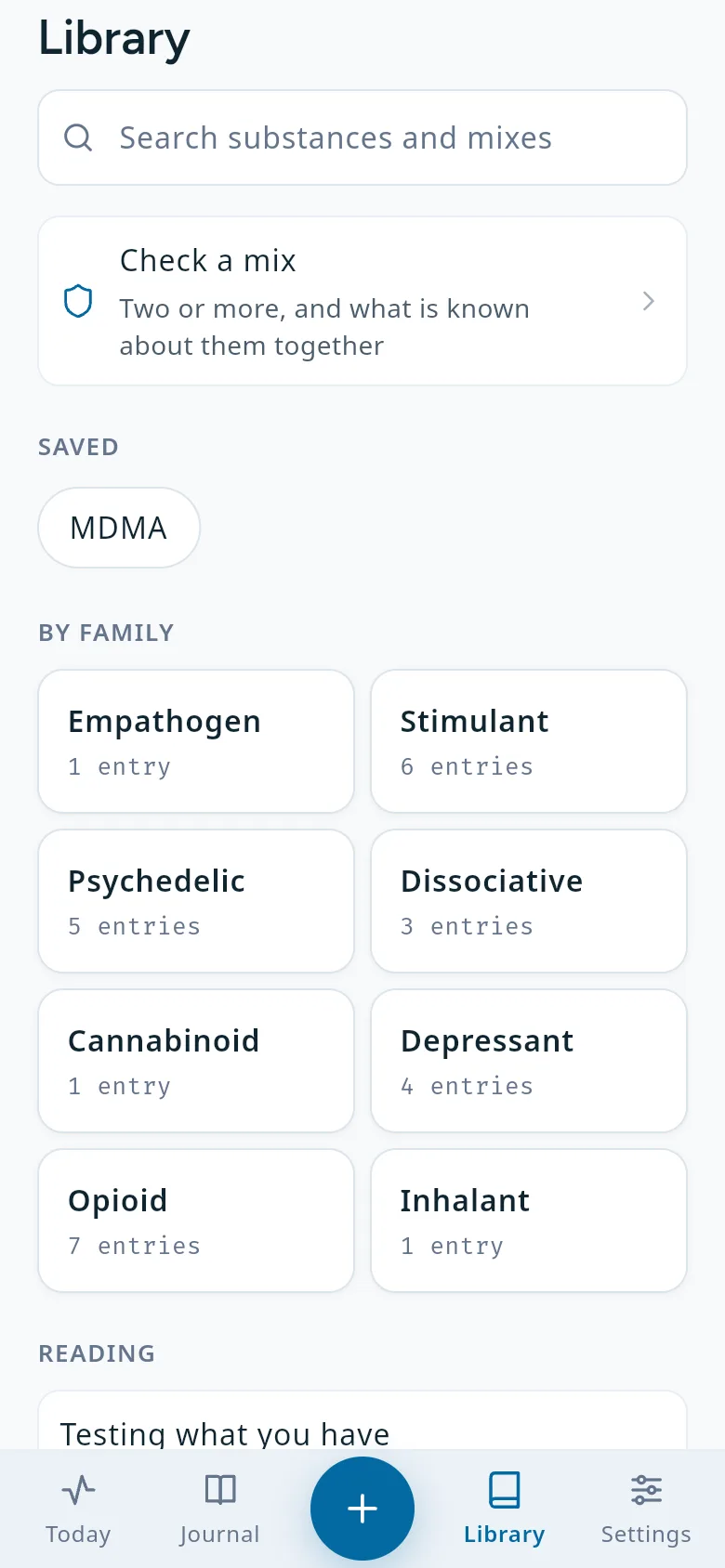
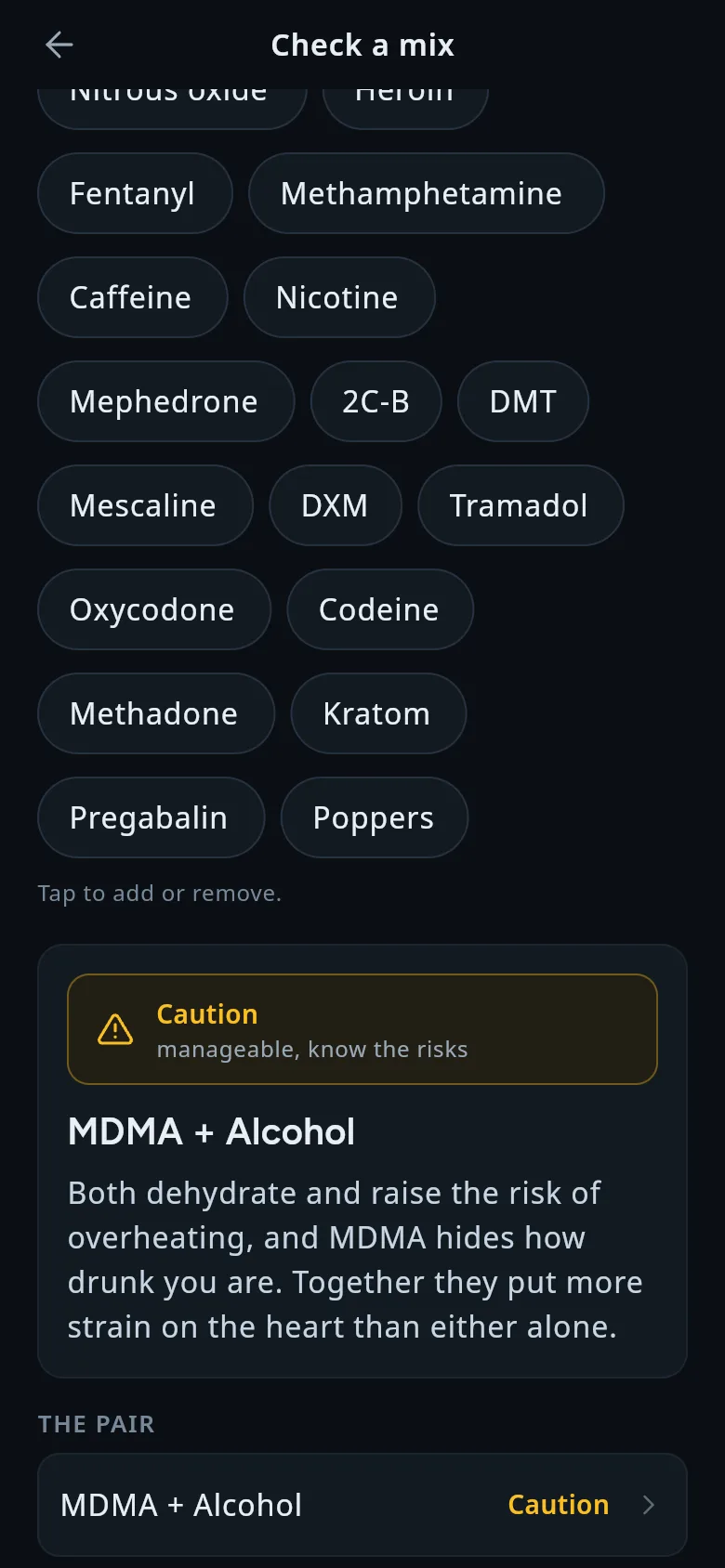
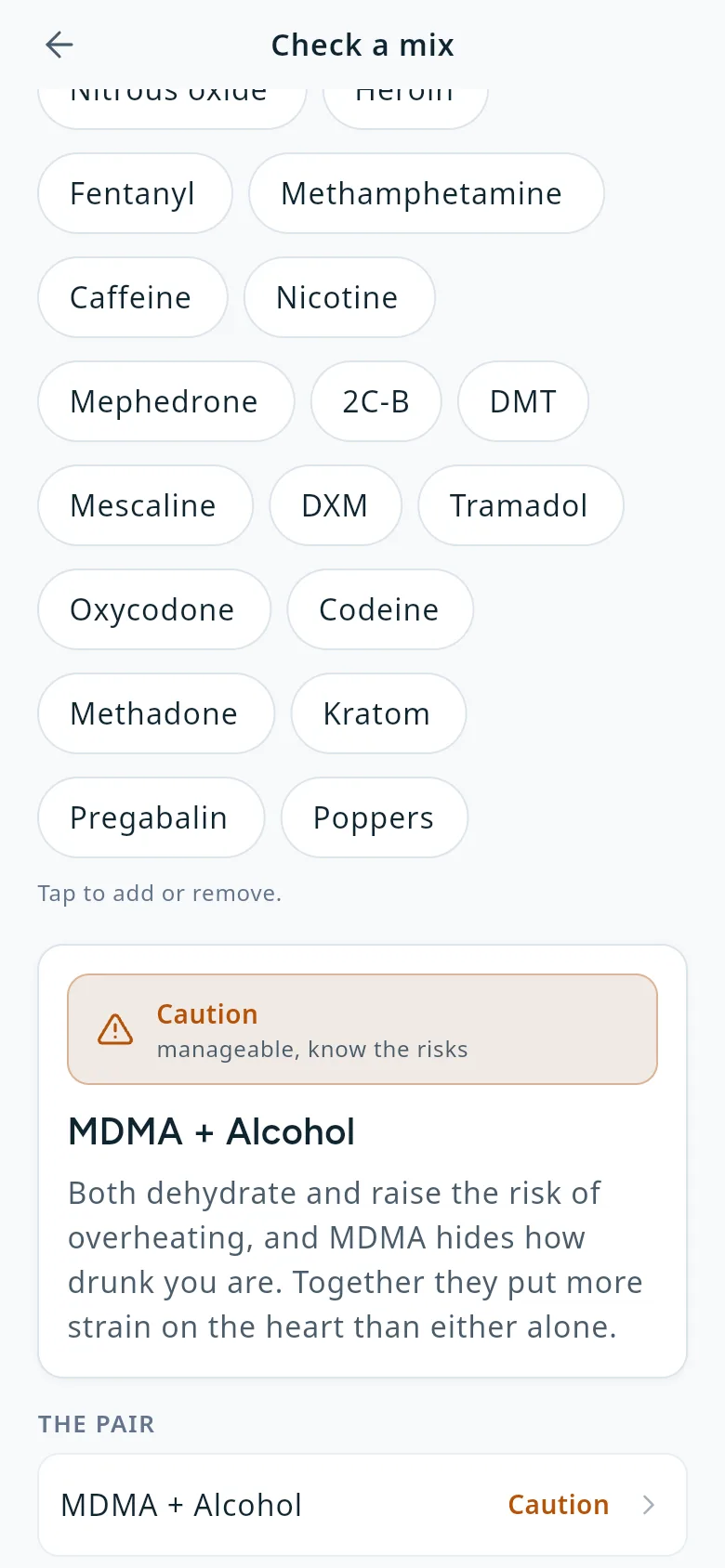
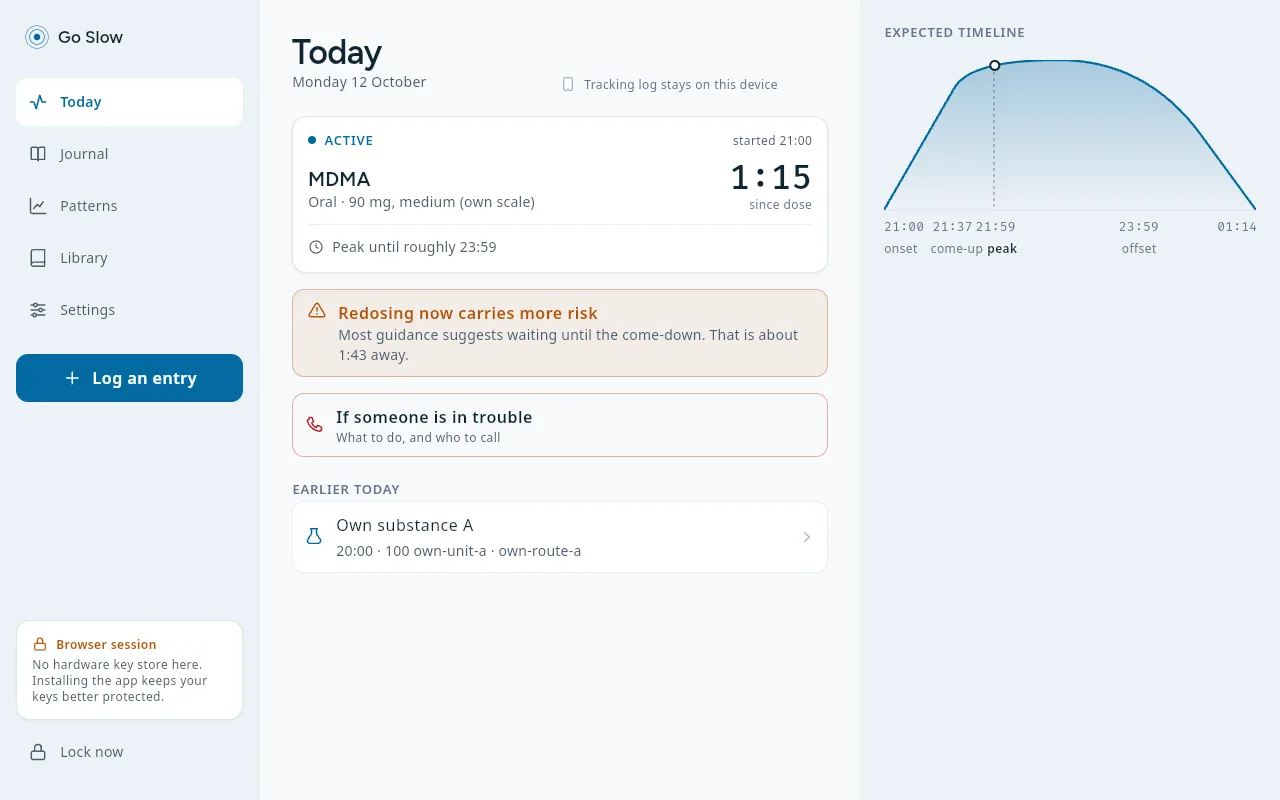
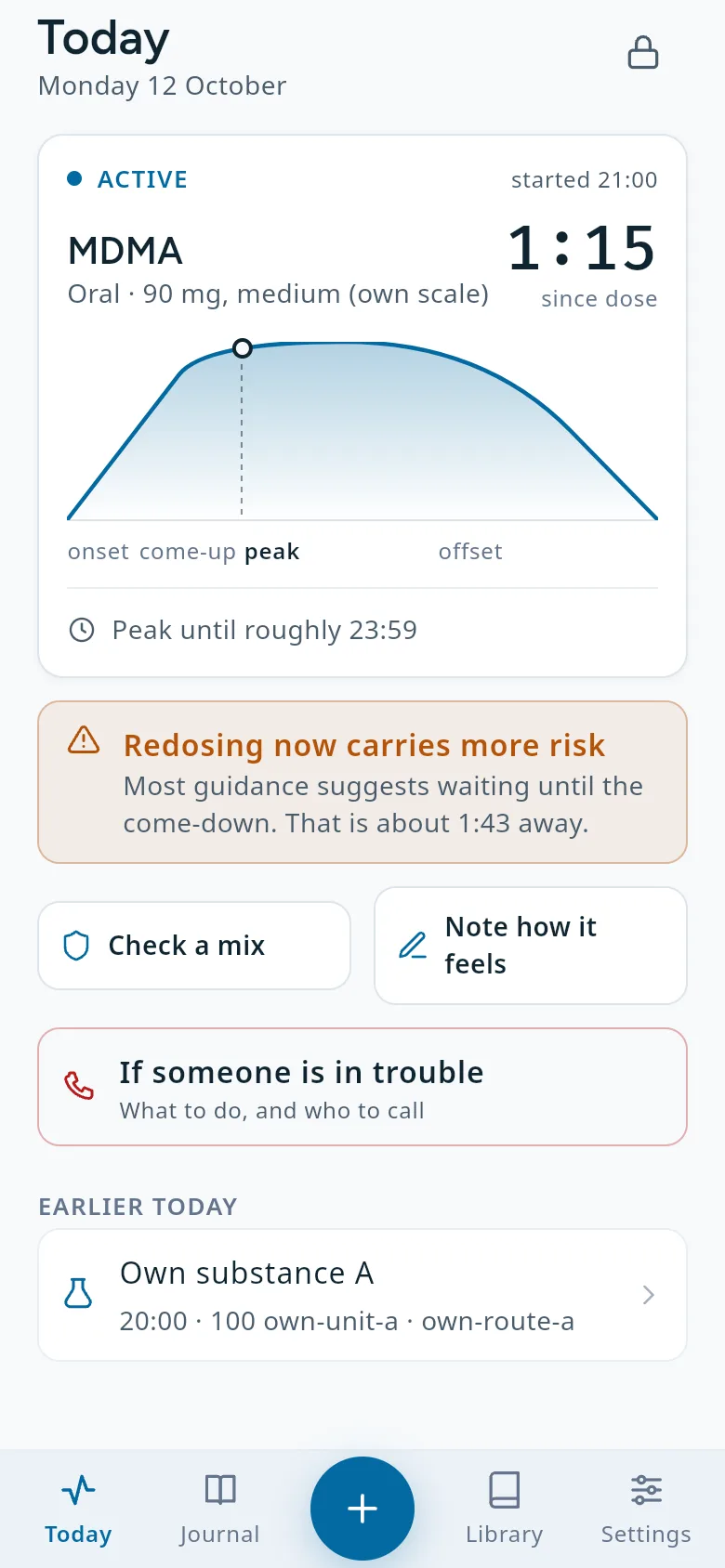
Screens from the app's test build, filled with made-up entries.
28 substances in the library so far. As of the October 2026 library.
How it is built, in plain words
Draft — awaiting reviewThe privacy promises below are each something the app can be checked against. Where one has a limit, the limit is said here too.
-
Your entries stay on your device, encrypted. What you log is stored on your phone or in your browser, locked with a key on that device. It stays there. Syncing your log to another device is designed, with its own switch and its own consent screen, but it is switched off in every build of the app today.
-
You do not need an account. Everything works without one. Accounts come later, after an independent review of how they sign you in. The staging build linked below already offers sign-up, for testing only; the first release will not. They are meant to add encrypted sync of settings between your devices and a way back into your account with a recovery code. The recovery code restores your keys, not your entries: an entry you have not exported lives only on the device it was logged on.
-
When sync arrives, the server stores only what it cannot read. Sync will be off until you switch it on, one kind of data at a time. Anything that syncs is encrypted on your device first, with keys only your devices hold. The server keeps it but cannot open it, and neither can the people who run the server.
-
The encryption has not been independently reviewed yet. The design and the code have been checked within the project, by AI review, as the library was. A review by independent cryptography reviewers is still owed before launch, as the library’s review is.
-
No trackers, no ads, no analytics. None of them is in the app, and its build fails if anyone adds one.
-
The one report that can leave, and only if you agree. If the app crashes, it asks the first time whether to send a report, and the answer is no unless you say yes. The report is stripped down on your device to the crash itself, and you can read every field before it goes. For now it goes straight to the project’s own server, which sees the internet address it came from and does not store it. A separate relay that would hide that address is not set up yet, and the app says so where it asks. The report itself is deleted after 90 days.
-
Library updates are public files. To keep the library current, the app downloads it like any public file. That download carries nothing you have logged. Learn more about how library releases are signed and checked
-
It never refuses a dose. No entry is refused and no mix is prevented. Where something carries a risk, the app says what can happen and leaves the choice with you. A tool that will not record something stops being used.
-
It never guesses about your substance. It shows what you entered, such as a weight, a dose, or a purity from a drug check, and adds no estimate or correction of its own.
-
Your patterns are worked out on each device. Charts and summaries are calculated from your entries where you are, and are never synced.
-
A browser is less protected than a phone. In a browser there is no hardware key store, you unlock with a password each session, and the browser itself can clear what the site has stored. The app says this where it matters and offers to install itself to make clearing less likely.
0 trackers, ads or analytics in the app.
Your device only is where your entries are kept.
Where the information comes from
Draft — awaiting reviewThe library is the part of the app that can hurt someone if it is wrong, so this is how it is made and checked.
-
Written from published sources. Figures come from official bodies, such as the EU drugs agency (EUDA), NIDA, the WHO and the NHS, and from established harm-reduction references, such as PsychonautWiki, TripSit, DanceSafe and Erowid. Never from a forum post, a seller or a news story.
-
Two sources, or one named. Every dose range and duration agrees with at least two of those sources, or the entry names the one source it follows. Figures are entered as the source states them, with no rounding to taste and no averaging across sources.
-
Sources on every entry. Each entry lists its sources and the date it was written against them, and the app shows both. The wording is the project’s own. Every substance entry, article, interaction list and mix result in the app says it is not medical advice.
-
Mix ratings follow a published chart. Ratings use the categories of TripSit’s combination chart and follow the chart wherever it rates a pair. Where it does not, a rating needs a named source behind it. Without one, the pair is shown as No data, never as a guess.
-
Signed, and checked by the app. Each library release is signed with a key the project holds itself, never on a build server or in the repository. The test releases so far are signed with a test key kept on the project owner’s own computer. The first public release will use a separate key, held the same way. Before using an update, the app checks the signature and every file in it, and it refuses an older release than the one it has. If a check fails, the app keeps the last library it verified.
-
Written by AI, under the project’s rules. The first library was written and checked by AI, under the rules above: two sources or one named, figures as the source states them, no sentence copied. No person qualified in this field has reviewed it yet. Organisations such as drug-checking services are meant to take over writing and reviewing it, through a hosted editor in which every change needs a second person’s approval.
-
The qualified review has not happened yet. Before launch, the library still needs a review by qualified people outside the project. Until then it is a draft.
Get the app
Draft — awaiting reviewStaging build, for testing. It runs in your browser and can be installed from there. It changes often.
-
Android: coming with the first release, as a direct download from the project rather than a store listing.
-
iPhone: planned for later.